Skateboarding is secretly fascinated with alternative authority figures.
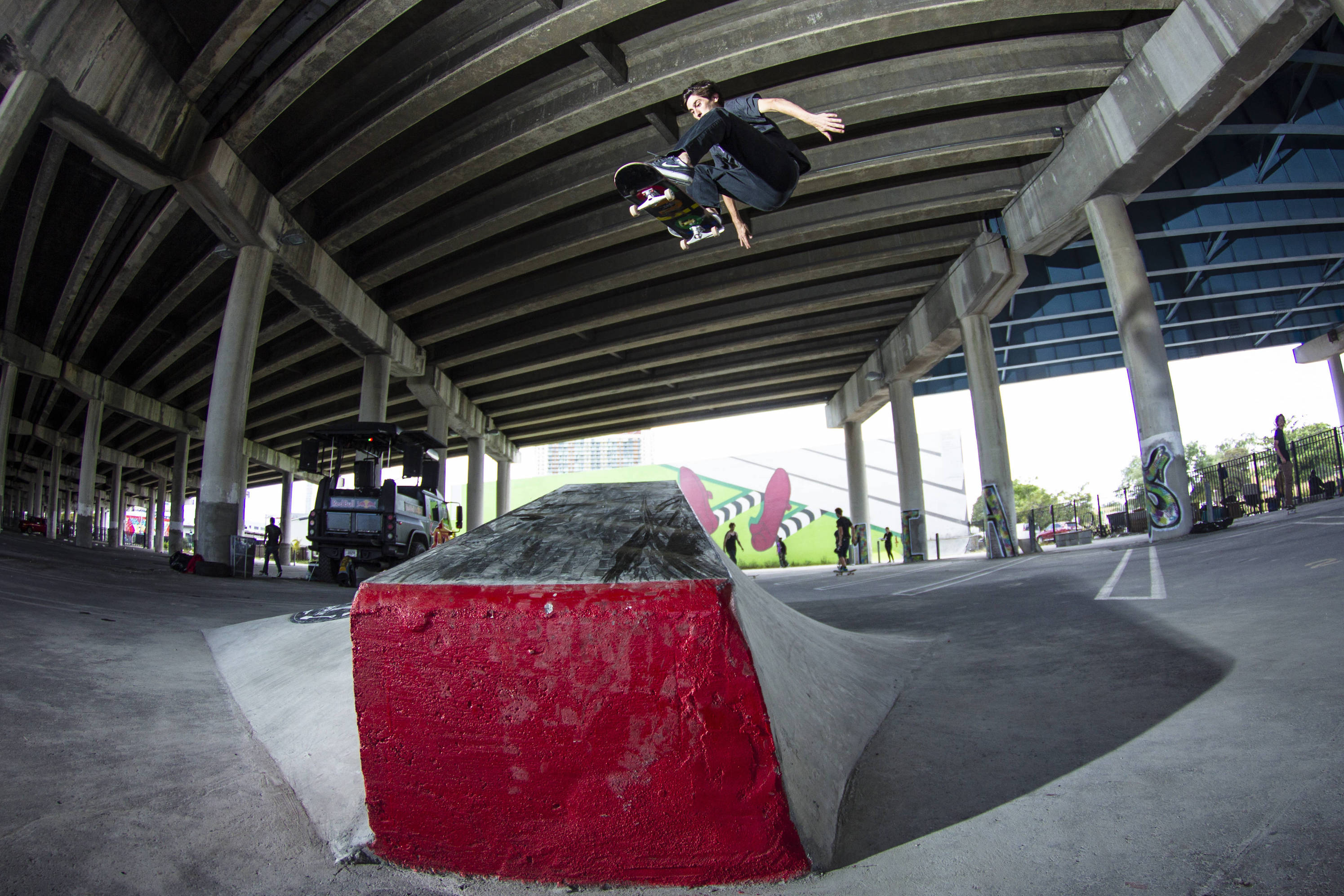
Danny Fuenzalida is a skateboarding authority, not just because he has had one of the longest skateboarding careers on record- but because within that career he is spectacularly well-travelled and has held many roles, from professional skater to community organiser, teacher and international judge.
Throughout it all, Danny has remained the quintessential out-all-day skate rat- as well regarded in the parking lot spots of Poland or Spain as he is in his adoptive home of Miami.
Driven ever onwards by what he calls the ‘treasure hunt and travel bug’, he has filmed more video parts than we can count on our fingers- from Think Skateboards, through Satori Wheels, independent releases like Trevor Prescott (RIP)'s Seasons series, Josh Stewart's influential Static output- plus scene videos, mini-docs and more.
In his role as one of World Skate’s most highly-regarded judges, he brings with him a lot of realism borne of experience in skateboarding’s trenches.
Honest, unsentimental and clear-eyed, he has what Corey Duffel refers to as ‘receipts’ stacked high on skateboarding’s spike of experience.
We like to think of it as skin in the game: here is the multi-passported globetrotter himself on South American scenes, the story of Lot 11 skatepark- and running on the power of dreams.

Ph: Mark Dillon
Hi, Danny- so as someone who came up in skateboarding when the old industry still had established pathways, can we break your life journey up into phases? Let me ask it in three parts!
Sure.
Tell us about your roots skateboarding in Chile.
So, I’m a Chilean born in Australia. I moved to Canada when I was seven and then moved to Chile at ten. I started skating at twelve, when one of my Canadian buddies David Barbour brought a skateboard back from his travels and showed me that you could ollie on a skateboard without bindings- that blew my mind. Growing up as a skateboarder in Chile… it was rad, because the skate scene was super-small and mostly every skater was friendly with each other. I got to be friends with some of the better and older skaters in the area of Santiago that way, helping me realize how much I needed to grow as a skateboarder- and also travelling to other sides of the city just to meet friends and skate different spots. Being from another country like Chile in those times was very different, because all we saw were the videos that we ordered as far as foreign skateboarding- and, like, magazines that my friends had subscriptions to.
Is it the most slept-on skate nation in Latin America?
I don’t really have an answer to that as far as slept-on… maybe Peru, Chile, Colombia, Uruguay and Argentina? Brazil and Argentina aren’t really slept on that hard, though…
Santiago has a huge scene, Valparaiso is sometimes called the SF of the Southern Hemisphere…guys like you and Spiro Razis helped put it on the map, but now you have people like Mathias Torres and Juan Carlos Aliste coming through… what can you tell us, there?
I started visiting Valparaiso and Viña del Mar when I was twelve going on thirteen- me and my buddy Daniel Spencer would take the bus down just to skate the marble plazas. We didn’t have any in Santiago. After a while, we started realizing Valparaiso was amazing due to its huge downhill, and awkward spots thanks to those hills. It’s definitely been rad over the years doing different trips to Valparaiso and Viña del Mar that way, getting to see the new spots over the years and the old spots- how people skate them differently, now.
It’s also been super cool seeing talent like Mathias Torres and Juan Carlos Aliste and others come out of Chile and prove to the world that Chills do have a strength in skateboarding. A lot of people don’t know that there’s a huge skate scene in Chile thanks to the skate parks that have come up over the years.
You’ve become one of the leading advocates of the Floridian scene through Skate Free, your big connection to Lot 11 skatepark, all the scene-promoting videos with Dabble VM and so on. Can you begin by explaining Skate Free to us?
Skate Free is an organization I founded about fifteen years ago, and it’s just been rad that we were able to build Lot 11 Skatepark. Thanks to my partners- Richie Effs and Nick Katz- and I, we have been able to give the public a free place to skate that’s a top-notch skatepark.
What makes that scene so great, to you? Is the relative isolation part of it? Is it that it is East Coast, but with good weather and unique architecture?
What’s great about the skate scene here in Florida is…. yeah, it’s the isolation where we’re not stuck following trends; kind of just do our own thing. And yeah- that East Coast crust is really cool, and the aesthetics here in Miami make for great videos. There’s a lot of things that locals would complain about in those things, like crusty spots and stuff -but when you’ve traveled a lot and you start realizing how cool it looks here, you can really appreciate it. Summers are brutally humid, but the winters are amazing.
Leading on from your work in the wider Florida skate scene- do you think it is important that skateboarding today becomes broader in terms of what it considers 'important'?
I honestly believe skateboarding is what you make it, just like where you live or anything you do in your life. Having said that, if I think it’s important that skateboarding becomes broader in terms of what’s considered important- I think that’s kind of how you look at the sport. You can go find yourself with friends enjoying a street session, not caring about anything in the world- or you could be filming, trying to be the best skater on film so everyone can see it. I think that’s up to you.
Also, you could be competitive and care about the competitive world, now- other countries have teams and their federations that take them traveling to compete, and try to make the Olympics… and those skaters have found a way to be happy with themselves, and skateboarding, through those means.
For the longest time, if you weren’t in California it would certainly be to your long-term disadvantage sponsorship or coverage-wise.... what has changed in that regard during your skating experience?
I definitely think that that has changed- so, I did get to see how that was like in the 90’s… I would say California and the northeast- like New York and Boston and Washington. But now there’s so many more ways to communicate and show off your talents that people are becoming known through their social medias or YouTube channel; not just how it used to be, where it was ‘film a video part for a sponsor that you ride for’- that’s how people saw your skateboarding.
Think Skateboards pretty much had their pick of the talent to come through SF at any point, but were they an early example of the current ‘go do your thing and send us the footage’ skate teams?
Yes, and no- I do believe we did put on people from seeing them while we were on the road a couple of times… maybe if we saw that they were amazing and they were riding for a distributor, we would put them on.
Did having a board sponsor locked-in stabilize your life in the US, or have you always travelled where the wind takes you?
I definitely think having a board sponsor locked-in stabilized my life as a skateboarder in the US- I never really let the wind take me where it took me; I ended up in Miami thanks to a relationship I was in.
Turning to your role as a World Skate Judge: being an authority figure in skateboarding is a thankless task, but many aspects of skateboarding are secretly competitive- even if only with yourself. Filmers are competitive, photographers are competitive… competition in one form or another in skateboarding is as old as the Z-Boyz. What do you think about that idea?
Yeah, being a judge is definitely a thankless task- countless hours of prep and even execution. Most people don’t leave the contest happy- but that’s the name of the game, and for those that realize how tough it is, they are thankful. What’s cool about the judges is, yeah, we’re competitive with ourselves not with each other- and we are trying to do the best job for every participant in these events.
How much would you say you enjoy judging during the event itself? It is a very, very long shift over the course of a week- and it must be stressful at times?
I enjoy the judging because I get to see the level of skateboarding and help everyone understand how we look at executed tricks by scoring them. It is a little stressful, but that’s when good preparation comes in handy. I’m also now part of the International Judging Committee, which helps create regulations to better further this sport, and help people understand how we judge.
Has anyone ever said that they think they got too many points?
Ha…highly doubt that.
Somebody has to arbitrate, whether they are a team manager, marketing manager, editor or judge, because in the end skateboarding culture is all about dissecting aesthetics.You can’t do that and please everyone at the same time, but equally we work in the power of dreams. How do you balance that, in your mind?
Honestly, I feel like I do divide myself up into all those situations- so it’s not easy. But I do dare to dream, and try to do the best possible to make it fair for everyone and help the sport where I can.
Corey Duffel said in A Closer Look that ‘having receipts’ is important when it comes to judging. Yours is quite an extensive receipt- why do you keep skating hard when you could be forgiven for cruising it from here?
I enjoy the act of skateboarding. That’s why I keep doing it and pushing myself to keep learning- but I appreciate you saying that. Randomly, Corey Duffel is one of the judges who’s opinion I respect the most- and it’s funny, when we judge together, we do butt heads from time to time. But what’s cool is, I think we both have such a high respect for one another that no matter what our opinions are about tricks or things, we try to find a common ground.
Tell us what else we need to know and shout out anyone we should know about?
Shout out to Garrett Hill, one of our head judges and Martin Karas from World Skate for believing in me and having me on board. Every judge that I’ve worked with over the years too: JB, Dani L, Manuel V, Marco, Susan, Russel, Emilio, Corey, Sierra P, and Lauro from World Skate. I mentioned my partners Nick Katz and Richie Effs at Skate Free to you already, but also anyone ever involved with Kast Skateboards like Valentine León, Juan Giraldo, Desmond White, Will Gomez, Jesse Villamor, Ryan Owen, Alex Marshall, and Charlos Padilla. Filmer and editor Carlos Mesa, and Justin Castillo. Professor Schmitt, as well.
Also all my skate buddies in Florida right now, like Jorge Moralez, Chris Freidstat, Wilfred Cortez, Jack Stein, Jason “Datsun”, Mike McDonald, Mike Mancini “Dango”, Brian Delatorre, Brad Cromer, Jaime Foy, Zion Effs, Jax Effs, Zach M- and the many more folks that have been a buddy along the way.
Ollie Photo: Matthew Roy/ Red Bull Content Pool